ERC
Remembering ERC champion Hołowczyc’s Poland victory 30 years on
It will have been 21 years since Rally Poland used all-asphalt stages when round three of the FIA European Rally Championship takes place next week (July 24 - 26).
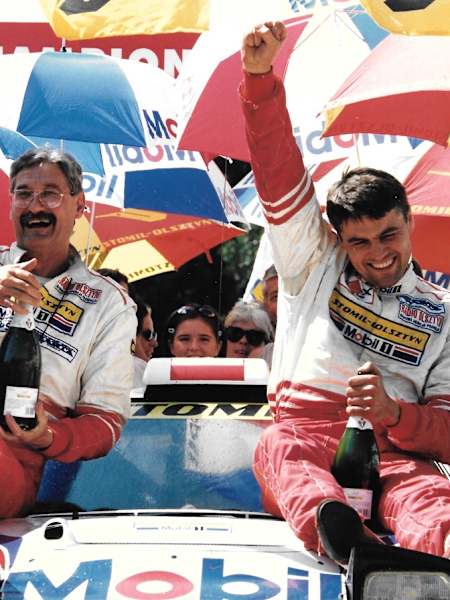
But Polish fans once had to wait almost as long for a home crew to win the event. That wait ended exactly 30 years ago – on 8 June 1996 – as Krzysztof Hołowczyc and Maciej Wisławski triumphed on the 53rd Rally Poland after a thrilling battle with Dieter Depping and Fred Berßen.
After more than 320 kilometres of timed action, the home heroes won by just 12 seconds. Their victory on an ERC round was also one of the most important moments of the 1996 Polish championship season, during which Hołowczyc and Wisławski claimed their second national title together.
Next week, Rally Poland once again brings two worlds together. It will be the fourth round of the FIA European Rally Championship and the fourth round of the KIQ Polish Rally Championship.
For Poland’s leading crews, competing on the country’s European qualifier has always meant more than fighting for national championship points. It is also a window to the world – a chance to compare their pace directly with drivers competing for the European title. That will be the case this year. It was also the case 30 years ago, when a strong international field assembled in the city of Wrocław.
“I remember the euphoria at the finish when, after 20 years, we won Rally Poland,” three-time event winner and 1997 European champion Hołowczyc recalls. “It was a fight with Dieter Depping, a battle for seconds until the very end, right up to the final special stage. When we won, Maciek and I could hardly believe it had happened.”
7,272 days of waiting
Before Hołowczyc and Wisławski’s triumph, the last Polish winners of Rally Poland had been Andrzej Jaroszewicz and Ryszard Żyszkowski in 1976 at the wheel of a Lancia Stratos HF. From that victory to the finish of Rally Poland in 1996, 7,272 days had passed – almost 20 years.
For Polish fans, it was an especially long wait, because Rally Poland has always held a unique place in the country’s motorsport history.
The 1996 edition was even more symbolic because it came 75 years after the first Rally Poland, held in 1921. Hołowczyc also entered the season as the defending Polish champion. Rally Poland was the fourth round of the 1996 Polish championship and the fourth of five consecutive victories for Hołowczyc/Wisławski. Their win in Wrocław therefore carried double significance – it was a breakthrough in the country’s most important rally and another step towards defending the Polish crown.
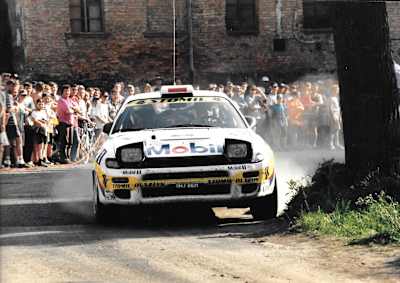
Hołowczyc set the pace on 13 special stages
© Jacek Gdowski
A jubilee Rally Poland on Lower Silesian asphalt
The 53rd Rally Poland was held on 6 - 8 June 1996 and basd in Wrocław. The competition began with a two-kilometre prologue around Wzgórze Andersa – an artificial hill in the Huby district, created after the Second World War from the rubble of destroyed buildings.
In total, the rally covered 795 kilometres, including 323.53 kilometres across 20 special stages. Friday 7 June was a true marathon with 12 stages and 201.32 kilometres against the clock. The final day, 8 June, brought another seven stages and 120.21 kilometres of competition. Sixty-seven crews started the rally, while 31 reached the finish.
The rally took place in sunny, hot weather. There was no rain lottery and no sudden changes in conditions. The result came down to pace, resistance to pressure, car preparation and precision on the classic asphalt stages of Lower Silesia.
“The German could cause trouble”
The list of favourites was long. Enrico Bertone arrived in Poland as the reigning European champion and winner of Rally Poland in 1995. Yves Loubet, the 1989 European champion, had extensive experience and success in the World Rally Championship. Dieter Depping was a three-time German champion and a two-time European championship runner-up.
Hołowczyc and Wisławski competed in a Toyota Celica 4WD. Depping and Berßen drove a Ford Escort RS Cosworth – at the time, one of the most competitive and successful Group A rally cars. That duel – Toyota versus Ford, a Polish crew against one of Europe’s strongest rivals – quickly became the main story of the rally.
Already after the prologue, rally director Jacek Bartoś accurately predicted that fans might witness something special. “It will be a very interesting sporting battle,” he said. “I hope the fans will see something truly extra. We have the best crews here, fighting for the European championship. I hope that, after many years without a Polish crew on the top step, a Polish crew will finally stand on the highest step of the podium. I think Hołowczyc’s main rival may not be Enrico Bertone, but Dieter Depping. He is a really fast, slightly underrated driver. If he drives the way he normally does, he could cause some trouble here.”
As it soon turned out, those words were almost prophetic.
Nervous driving, a winning prologue
Hołowczyc began the rally by winning the Wrocław prologue, but even the fastest time did not leave him fully satisfied. After SS1, he said his driving had not been what he had expected.
“This may sound funny, but I am not satisfied,” Hołowczyc said. “My driving was ‘edgy’, heavy, and I did not know what was happening with the car. I thought it was due to changes and new parts in the drivetrain, but later it turned out that the front wheels had too much toe-out, and that was the reason for my ‘wild’ driving. I am happy with a decent time, but I think you can always go a little bit faster.”
It was the first sign that victory would not come easily. Depping won the first two longer stages – Sobótka–Sulistrowiczki and Rościszów–Lubachów – but Hołowczyc responded on SS4 Jodłownik–Srebrna Góra and regained the lead. From that point on, the rally became an exchange of blows measured in single seconds.
After SS5 Żdanów–Młynów, Hołowczyc made no secret of the fact that he was driving on the limit.
“It is very difficult,” he said. “I really cannot go any faster. I am driving at my very best pace. You can see the effects on the car. Sometimes I am missing about 20 centimetres to fit the rear of the car through a corner. But I feel that Depping is also doing absolutely everything with his car.”
The German responded calmly but announced an attack. “I think I can go a little bit faster. It is very hot, which is not good for the car. I will attack in the afternoon,” Depping said.
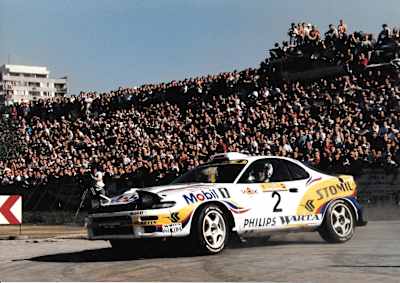
Thousands of fans cheered Hołowczyc to a popular home win
© Jacek Gdowski
One second after more than 200 kilometres
Friday’s leg was a display of extraordinary intensity. Hołowczyc and Depping pulled away from the rest of the field. Bertone, one of the main favourites, retired on SS12, Ludwikowice – Kamionki, when he crashed his Ford Escort RS Cosworth into an electricity pole, causing power cuts in nearby villages. The crew was unharmed, but the reigning European champion lost his chance to fight for victory.
After the same stage, Hołowczyc summed up the character of the whole rally in the shortest and most accurate way.
“We are constantly cutting seconds with Depping. Stage by stage – he takes two, we take two,” he said at the finish of the twelfth test.
At the end of Friday’s leg Hołowczyc led Depping by just one second. At the time, rally timing was recorded to the nearest full second, meaning this was the smallest possible gap visible in the classification. Still during Friday’s competition, the German made it clear he was not going to give up.
“At the moment Hołowczyc is about nine seconds ahead of me, but tomorrow I will definitely drive at 100 per cent and we will see – maybe I will win,” said the driver from Hanover.
Rościszów – Lubachów – the stage of truth
The final day began exactly as Depping had promised. The German won the Sobótka–Sulistrowiczki stage and took the lead – also by one second. Victory was decided on SS15 Rościszów – Lubachów, one of the classic Rally Poland stages.
For Hołowczyc, this stage was special. Earlier, on SS8, also on Rościszów – Lubachów, he had taken his 30th special stage win in a European championship round. A few hours later, the same section of road became the scene of his decisive attack.
Hołowczyc and Wisławski beat Depping and Berßen by 10 seconds, regained the lead and never gave it up again. After 20 special stages, 323.53 km of competitive action and three days of battle, they won Rally Poland by just 12 seconds. In theory, at the winners’ average speed of 112.1 km/h, 12 seconds corresponded to only 373.6 metres of driving.
The scale of the battle was exceptional. Hołowczyc won 13 special stages, Depping won 10, and only one stage – SS13 – was won by a driver outside that pair. It was Yves Loubet, who ultimately finished third. Some stages ended in dead heats, which is why the combined number of stage wins for the two drivers exceeds the number of stages held.
A victory that changed the perspective
For Hołowczyc and Wisławski, Rally Poland 1996 was a victory with several meanings. They ended an almost 20-year wait for a Polish triumph in the country’s most important rally. They defeated strong rivals from the European elite. They scored important points in the European championship. And in the context of the Polish Rally Championship, they moved much closer to their second Polish title together.
For Hołowczyc, it was also the first of 10 ERC victories. The win in Wrocław confirmed that a Polish crew could not only compete with the best on the continent but also beat them in a direct fight.
“If we won a European championship rally, at a time when we had previously been happy just to see a Polish driver make it into the top 10, then we had to go further. We had to believe, build a team and get moving,” Hołowczyc says today. “I think we started a whole machine back then. Rallying gained nationwide popularity, sponsors appeared and the level of competition in the Polish championship was really high,” added ‘Hołek’.
Rally Poland 1996 remains one of the symbols of that era – sporting proof that competing in Poland’s round of the European championship can be not only a test for a national crew, but also a breakthrough.
History returns to asphalt
Three decades later, Rally Poland is opening a similar story once again. After 21 editions on gravel special stages around Mikołajki in Masuria, the event returns to asphalt – this time in the Silesian Voivodeship.
For Polish crews, it will once again be a chance to compare their pace with Europe’s leading competitors. Just like in 1996, Rally Poland will become a meeting point between the national championship and international competition. The story from 30 years ago is a reminder that such confrontations can change the course of a career – and stay in fans’ memories for decades.
The numbers still impress: a total distance of 795 kilometres including 323.53 kilometres over 20 special stages, a one-second gap after Friday’s leg and a 12-second winning margin at the finish. But the most important thing remains what Hołowczyc remembers to this day – the euphoria at the finish and the feeling that something truly ground-breaking had just happened.
Words: Rafał Rezler Photos: Jacek Gdowski


